
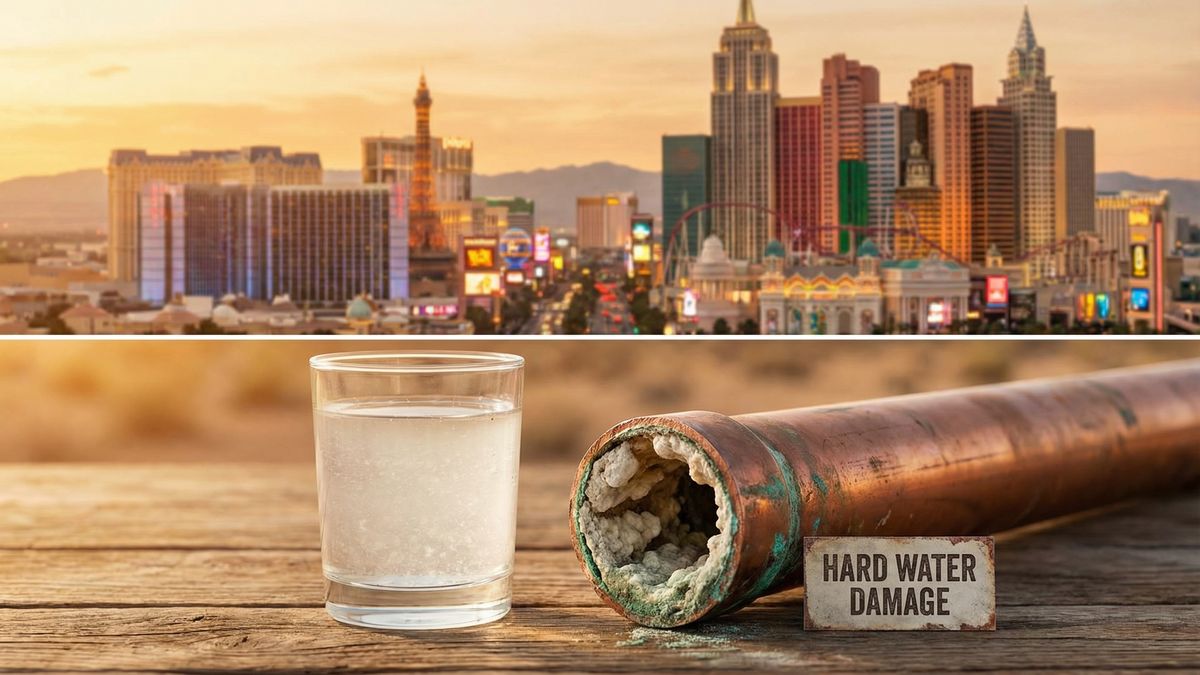
You see the chalky white residue on your faucets and shower doors. It’s a constant battle, but you probably just write it off as a normal part of living in Las Vegas. It’s just hard water, right? No big deal.
But what if I told you that same chalky buildup is happening inside your home’s plumbing? Silently, day after day, it’s constricting your pipes, weakening their walls, and setting the stage for a catastrophic failure. That “harmless” hard water is a destructive force, and your home is its target.
The good news is that you don’t have to live in fear of a sudden flood or a slow, hidden leak destroying your foundation. Understanding what’s really happening inside your pipes is the first step. From there, modern plumbing solutions can protect your home and give you peace of mind for decades.
The Hidden Enemy: Las Vegas’s “Very Hard” Water
Let’s not mince words. The water here in Las Vegas is some of the hardest in the entire country. Sourced from Lake Mead, our water travels through mineral-rich rock, picking up a heavy load of calcium and magnesium along the way. According to the Las Vegas Valley Water District, our water clocks in at around 278-291 parts per million (PPM), which is officially categorized as “very hard.”
Think of these minerals like liquid rock flowing through your plumbing. Over time, they don’t just flow through. They stick to the inside of your pipes, creating a layer of rock-hard scale. This isn’t just unsightly; it’s the beginning of several serious problems.
How Scale Buildup Chokes Your Plumbing
Imagine your home’s plumbing system as its arteries. That mineral scale is like cholesterol, slowly closing the arteries and restricting flow. At first, you might not notice it. But over years, the diameter of your pipes shrinks significantly.
This leads to a noticeable drop in water pressure across the whole house. Your showers might feel weaker, and it could take longer to fill a pot with water. It’s a gradual change, one that’s easy to get used to, but it’s a clear sign your pipes are struggling. This is one of the classic warning signs of a major plumbing issue brewing beneath your floors.
The Corrosive Truth About Copper Pipes
For a long time, copper was the gold standard for plumbing. It’s durable and reliable, but it has a critical weakness when faced with Las Vegas’s hard water. The high mineral content creates an aggressive environment that accelerates corrosion.
This corrosion doesn’t eat away at the pipe evenly. Instead, it creates tiny, localized pits that eventually turn into pinhole leaks. These leaks are incredibly deceptive. They are often too small to affect your water meter but large enough to slowly saturate your drywall, subfloor, or even the concrete slab your home is built on. This is a primary cause of slab leaks, which you can learn more about in our Slab Leaks Complete Guide.
Polybutylene Pipes: A Ticking Time Bomb
If your home was built between the late 1970s and mid-1990s, you might have polybutylene pipes. This flexible gray plastic was once seen as a cheap and easy-to-install alternative to copper. Unfortunately, it proved to be a disaster waiting to happen, especially in areas with our kind of water chemistry.
The minerals in our hard water react with the chlorine used to disinfect the water supply, and this combination aggressively attacks the polybutylene material. It makes the plastic brittle from the inside out. The pipe might look fine on the outside, but it’s becoming fragile and weak, ready to rupture without any warning.
The Modern Solution: Why PEX-A Is Superior
So, what’s the answer to this relentless assault on your pipes? The solution lies in using a material that is immune to the effects of hard water. Today, that material is PEX-A, a flexible and incredibly durable polymer tubing.
Unlike copper, PEX-A does not corrode. Its smooth interior surface makes it very difficult for mineral scale to get a grip, preventing the buildup that plagues metal pipes. It’s also more flexible, allowing it to expand and contract with temperature changes and resist bursting even if the water inside freezes. A whole-house repipe with PEX-A is the most effective way to permanently solve the problems caused by Las Vegas water.
By replacing your old, vulnerable copper or polybutylene system, you’re not just fixing a problem. You are investing in the long-term health and safety of your home. You get better water pressure, eliminate the risk of leaks, and gain invaluable peace of mind. While the cost of a repipe is a consideration, it pales in comparison to the expense and headache of a major slab leak repair.
Worried About Your Water Quality? Get a Second Opinion.
Las Vegas water is brutal on pipes. If you're seeing signs of damage or another company gave you a quote, call us. We'll tell you exactly what's going on and what your real options are.
Call or Text (702) 605-6169 Book Your Appointment Online